Mark VII Suit
Iron Man Armor
Earth-616
DEFUNCT
First Appearance:
Image
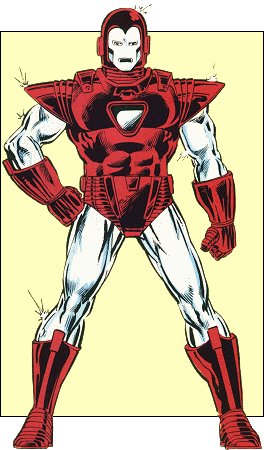
Historical Data
None at this time.
Technical Data
- Specifications: Iron Man Armored, Flight-Capable, Environment Suit, Mark VII
- Designer: Anthony Stark
- Major Contractor: Avenger West Coast
- Armor exterior Dimensions:
- Height (overall) : 78 in.
- Width (overall) : 34 in.
- Width (short axis) : 21 in.
- Weight: 240 lbs.
- Armor composition:
- Surface/primary Layer: Molecularly aligned crystallized iron over a base of titanium nitride. Metallized paint is precise thickness to destructively interfere with RADAR band microwaves.
- Secondary Layer: Comprised of various thermoelectric generators, temperature insulators and regulators.
- Tertiary Layer: Consists of two independent, 'crimped' armature electric motors that are aligned at right angles to each other, which can simulate human musculature movement.
- Special Features: Each layer possesses integrated communication, power-handling and control circuitry - with regions, which contain certain large area specializations, such as the simulation of a specific muscle.
- Note: Suit's microscopic scale chain mail is made rigid by numerous computer-controlled magnetic beam generators. These generators can sense and amplify the suit wearer's motions and strength. Discrete networks of them are arranged, in conjunction with the full-body system of DC motors, to mimic the function of human musculature.
- Armor Articulation Motivation:
- Musculature enhancement: The armor enables its wearer to lift (press) approximately 80 tons under standard operating conditions.
- Limits: When directly tapping a sufficiently potent power source, the armor can be boosted to Class 100 strength (able to lift in excess of 100 tons) for several seconds at the risk of having a total system seize-up.
- Power Supply:
- Type: High-density storage battery, AC/DC electricity.
- Primary: Beta particle generator, creating constant current from passing beta particles that continually bombard Earth.
- Secondary: Solar power converters, regrouped in microscopic ridges for improved collection efficiency, arrayed on shoulders and headpiece.
- Tertiary (back-up): Increased efficiency of conversion of electric field potentials into usable electricity. Mark VII two orders of magnitude more efficient than Mark VI.
- Armor System Controls:
- Type: Automatic, computerized, body motion following.
- Sub-Systems: Local networks of muscle groups and high-density computers, which control large scale movements such as walking.
- Special Features: Armor is comprised of finely tessellated mail, which can minimize sudden compressions, such as a blow, by racially dissipating the energy throughout the suit.
- Articulation Seals/reinforcement: All magnetic. Due to microscopic construction, seal topology allows a 4.5-inch diameter wrist cuff (for example) to have a practical circumference of 12 inches. This allows for a greater area over which a magnetic seal can be affected.
- Life Support:
- Range: High altitude to deep water: 130,000 feet above to 1,800 feet below sea level.
- Air Supply Duration: 1.2 hours
- Pressure: Normal atmosphere (14.7 pounds per square inch) maintained internally over a wide range of external pressures.
- Temperature: 73° Fahrenheit internal, from -185° F to 2,500° F internal, from 2,500° to 15,000° F external.
- Environment Design Program:
- Type: Full spectrum chemical, biological, nuclear environment
- Range: Two months on filtered external air
- Exposure: Low-level radiation over 2 month period; suit can tolerate short periods of high radiation by stepping up magnetic beam generator's activity
- Propulsion Systems:
- Type: Electric powered turbines in boots and jet pack.
- Maximum Speed: Mach 1.2 (960 mph)
- Life Capacity: Normal flight configuration 3,200 lbs. High thrust: 5,300 lbs.
- Range: N.F.C., About 2,000 mile (100 % load), 3,900 miles (50% load). H.T.: About 800 miles (100% load), 1,000 miles (50% load), about 7,500 miles (unloaded, ballistic flight)
- Fuel: Solar energy converted to electricity to power exceptionally efficient turbines.
- Weapon Sub-Systems:
- Offensive:
- Primary: Repulsor Rays
- Description: Particle beam emission units; microscopic matter projected at the speed of light. Speed can be reduced cybernetically by dampers at point of origin to lessen power level and control destructive force.
- Range: 100 yards
- Limits: The suit palm blasters are able to fire for very short periods of time. The duty cycle allows for a 25% cooling period.
- Secondary: Uni-Beam
- Description: The uni-beam is the blanket term for all of the armor's various light and force beams (visible, infrared, ultraviolet, tractor, laser, image inducer and electromagnetic pulse)
- Range: 50 yards (approx.)
- Tertiary: Pulse bolts
- Description: Plasma discharges that build in intensity as they travel through atmosphere, picking up static charges.
- Range: 200 yards (after traveling maximum range, pulse bolts dissipate, unable to hold cohesiveness due to static overload)
- Defensive:
- Primary: Energy shield
- Description: Laser-absorption grid generated by armor to convert incoming energy source into stored power or to create power feedback to the offensive source.
- Secondary: Electromagnetic pulse (E.M.P.)
- Description: Energy-dampening field generated by armor. For a six-minute period, the E.M.P. disrupts all energy sources within a 50-yard radius of the armor (a small solar back-up, shielded from the E.M.P., allows armor's life-support to continue during this time at minimal function).
- Tertiary: Stark R.F.S. Mark VII targeting computer
- Description: Although this computerized system is used in offensive tactics (i.e. repulsors, pulse bolts), it also possesses the defensive to lock-in and track incoming targets (up to 60 at one time). All information is relayed to L.E.D. read-out in the helmet.
Significant Issues
- First appearance
More Media