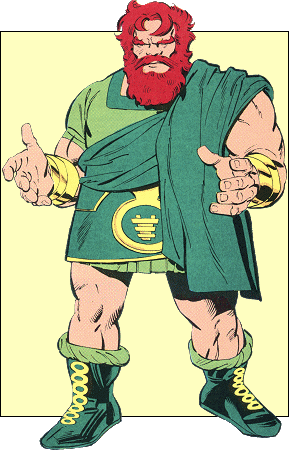
Zeus is the youngest son of Cronus, ruler of the superhuman extradimensional race of Titans, and his wife, the Titaness Rhea. Cronus and Rhea were the offspring of the sky god Ouranos and the primeval Earth goddess Gaea. (Ouranos and Cronus are not to be confused with the Eternals Uranus and Chronos, the latter of whom is also known as Kronos). Cronus overthrew his father's rule by fatally wounding him. The dying Ouranus prophesied that Cronus would likewise be overthrown by one of his own children. As a result, upon the birth of each of his own children, Cronus had the infant imprisoned in Tartarus, the most dismal section of the extradimensional underworld known as Hades. The offspring he sent there were Pluto, Neptune, Hera, Demeter, and Vesta. (Later, legends erroneously claimed that Cronus had actually swallowed his children and that they remained alive inside him until Zeus released them.).
Appalled at the mistreatment of their children, Cronus's wife Rhea concealed her sixth pregnancy from him and secretly gave birth to Zeus on Mount Lycaeum in Arcadia, an area of the land now known as Greece. Rhea gave the infant Zeus to the safekeeping of Gaea, who hid the baby in the cave of Dicte on Aegean Hill on the isle of Crete, where he was tended by various minor goddesses.
Zeus grew to adulthood among the Shepards of Mount Ida, Grete, and then set about taking revenge on Cronus. Zeus went down into Tartarus and freed his siblings, who had all now grown to adulthood, Zeus also freed the three one-eyed giants called Cyclopes and the three hundred-handed giants called Hekatonchieres, all six of whom Cronus bad imprisoned there for fear they would help overthrow him. The grateful Cyclopes taught Zeus how to wield his energy-manipulating powers in battle. Zeus and his allies fought a ten year war with the Titans which ended with Zeus's victory. He imprisoned most of the male Titans in Tartarus and established himself in the small "pocket" dimension of Olympus as supreme ruler of the Olympian race.
Zeus married the goddess Hera, but he engaged in many affairs with goddesses and with mortal Earthwomen both before and during the Heroic Age of ancient Greece. Some of his children were gods; others were mortal human beings such as Helen of Troy. Zeus's son by the mortal woman Alcmena, Hercules, was born a mortal, but Zeus transformed him into an immortal god later.
Zeus, Hera, Neptune, Demeter and Vesta, together with Zeus's children Apollo, Ares, Artemis, Athena, Hephaestus, Hermes, and Venus, comprised the membership of the high council of the Olympian gods known as the Pantheon. Vesta later resigned her seat in the council in favor of Zeus's son Dionysus. Zeus's brother Pluto was not a member of the Pantheon, preferring to spend virtually all of his time within Hades, which he ruled.
In ancient times Zeus and his fellow Olympians successfully defeated challenges to their rule by the giants Otis and Ephialtes, by a small army of superhuman giants, and, most dangerously, by the monster Typhoeus, father of Typhon, the Titan who has menaced the Olympians in recent times.
After the end of the Hyborian Age, the Olympian gods sought worshippers on Earth. Neptune became the patron god of the water-breathing Atlanteans. Zeus sought that the Olympian gods be worshipped by the people of the land known as Greece. Zeus learned that Greece's Mount Olympus, the location of the main interdimensional nexus between the Olympian dimension and Earth, lay near Olympia, the principal city of the Eternals. Zeus and his daughter Athena, goddess of wisdom, held a meeting with Zuras, the leader of the Eternals, and his daughter Azura. Noticing the strong physical resemblance between Zeus and Zuras and between Azura and herself, Athena suggested that the Olympian gods and the Eternals form an alliance whereby the Eternals would act as the gods' representatives on Earth. The other three enthusiastically agreed, and Azura took her current name of Thena to signify the signing of the pact. However, over the years many ordinary human beings came to think of many Eternals not as the gods' representatives but as the gods themselves. This led to a growing resentment by the gods towards the Eternals which recently erupted into a brief war. However, today the Eternals and the Olympian gods are again at peace with each other.
Worship of the Olympian gods spread from Greece to Rome and throughout the Roman Empire. The gods intervened frequently in human matters at first, as in the Trojan War, but did so less as time passed. When Christianity finally replaced the worship of the Olympian gods in the Roman Empire, Zeus decided that the time had come for the Olympians to break most of their ties with Earth. Neptune, however, was still allowed to watch over his Atlantean worshippers.
Since the worship of the Olympian gods had died out, Zeus forbade his brother Pluto, ruler of Hades, the Olympian underworld, from collecting any more of the souls of the dead from Earth. Pluto obeyed the edict resentfully. Finally, the bitter Pluto convinced himself that Zeus had proven himself to be an incompetent leader by allowing the worship of the Olympians to come to an end. Zeus, noting Pluto's increasingly ominous rebelliousness, warned him against attempting to overthrow him. Nonetheless, Pluto has attempted unsuccessfully to overthrow Zeus, as has Zeus's own son, the war god Ares.
However, despite the end of the worship of the Olympian gods, Zeus has retained affections for and interest in the people of Earth.
A millennium ago Zeus' son Hercules led a band of warriors he had transported through time from ancient Greece to battle Norsemen who were under the protection of the Asgardian god Thor. This conflict led to war between the Asgardians and Olympians. Zeus secretly met with Odin, ruler of the Asgardians, and the two gods not only put an end to the war, but also formed an alliance to defend Earth from danger posed by the alien Celestials. Odin and Zeus met with the heads of the other races of gods who were or had been worshipped by Earth mortals to discuss the Celestials' possible threat to Earth, and then Odin, Zeus, and the Hindu god Brahma went to confront the Third Host of the Celestials on behalf of all of Earth's gods. However, Odin and Zeus were forced to pledge not to interfere with the Celestials when the Celestials threatened to seal off the interdimensional passageways connecting the gods' dimensions with Earth. As a result of this pledge, the Olympian gods had to lessen their contact with Earth, although Zeus's offspring Hercules and Venus have spent periods living among Earth human beings in recent years. The Celestials' Fourth Host recently decided to spare Earth from destruction and has left the planet.
Today Zeus remains the ruler of the Olympian gods and of Olympus itself, as well as a staunch ally of the Asgardians.
An alternate future of the 24th century has been glimpsed in which Zeus and the other Olympian gods, except for. Hercules, leave Olympus for another plane of existence. Hercules remains behind to father a new race of gods. Whether or not the Olympian gods will come to such an end in what becomes the "mainstream" future is as yet unknown.