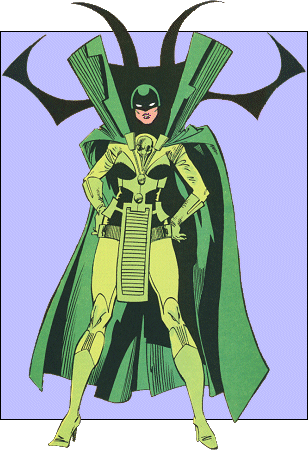
Strength Level: Hela possesses Class 100 strength,
enabling her to lift (press) over 100 tons. She has been
able to hold her own in hand-to-hand combat with Thor himself.
Known Superhuman Powers: Hela possesses the conventional
attributes of an Asgardian woman ("goddess") although
in fact her parents may have been members of the race of
giants of Jotunheim, as well as certain special abilities
that pertain to her role as a death goddess. Like all Asgardians,
she is extremely long-lived (although not immortal like
the Olympians), at least as long as she wears her cloak,
immune to all diseases, and resistant to conventional injury.
(Asgardian flesh and bone, including Hela's, is about 3
times as dense as similar human tissue, contributing to
all Asgardians' superhuman strength and weight.) Her Asgardian
metabolism gives her far greater than human endurance at
all physical activities, though Hela rarely feels obliged
to perform undue exercise.
As a goddess of death, Hela holds the power of life and
death over the gods of Asgard. Death for an Asgardian is
somewhat different from death for an Earth human being.
In both cases, the corporeal body ceases all functions and
activities, but whereas mortal spirits flee the physical
form at the moment of death, the spirits of gods remain
in their bodies until the death goddess draws them out and
dispatches them to her realms. These spirits (or astral
selves) remain integral for eternity and reside, apparently
forever, in the otherdimensional realms of Hel and Niffleheim,
where they take on a quasi-physical existence. The souls
of those who die heroically in battle remain within their
bodies and are accompanied by Odin's Valkyries into Valhalla,
where the deceased heroes lead a new physical existence.
These "dead" heroes are known as the Einherjar.
Hela too accompanies these heroes on their journey to Valhalla,
but she has no right to govern them.
Although Hela is usually content to wait until an Asgardian
is on the verge of succumbing to fatal wounds before she
touches him or her and draws the spirit from his or her
body, she can also kill perfectly healthy Asgardians with
her touch if she so chooses. Although Hela's touch of death
is effective even when she touches someone with her gloved
hand, she must contact that person's bare skin for him or
her to die. However, Hela can also project mystic bolts
that will cause their target to age or die, even if they
strike a portion of the target's body that is covered by
clothing.
Hela also has the power to restore life to recently deceased
gods as long as their spirits have not left the sheaths
of their bodies. She does not exercise this power often.
While Hela's touch is also fatal to mortals, she does not
generally come to Earth or have much traffic with human
lives. The souls of immortals are her province, not those
of human mortals.
Hela can generate great mystical power within her hand,
enabling it to strike a powerful blow that can rend even
the strongest Asgardian flesh. She calls this power that
of her "hand of glory."
Hela can levitate herself with ease. She has great power
to cast illusions, and thus can disguise herself and even
the true appearance of as much of her realm as an observer
in one area can see. Presumably Hela has other, unrecorded
powers as well, which enable her to maintain her control
over the vast numbers of the dead in her two realms. The
dead warriors in her realm are virtually mindless when acting
on her behalf, and are governed solely by her mental control.
Hela is able to travel about in her astral form, possessing
the same powers of death as her physical form has. Because
of her Asgardian metabolism, she does not have any limitation
on the amount of time she can spend out of her physical
form, unlike human astral projectionists.
Limitations: When wearing the garment that serves
as her cloak, cowl, and headdress, Hela's body is fully
alive and healthy. However, deprived of her cloak, Hela
reverts to her true form. The right side of her body is
fully alive, but the left side is dead and decayed. Legend
has it that Hela was born in this condition. It has been
theorized that without her cloak, Hela would be unable to
leave the realms of the dead. It has been demonstrated that
without her cloak, Hale's life force is insufficient to
maintain her usual physical strength. Indeed, she is unable
to stand or levitate herself, or to project mystical bolts,
and can barely crawl. Donning her cloak once more will restore
Hela to full vitality; even simply touching it would again
enable her to stand.
Realms: Hela rules Hel and Niffleheim, two of the
Nine Worlds of Norse mythology. The two realms lie on the
same dimensional plane, which is different from that of
either Earth or Asgard. Mystical conditions are such in
both Hal and Niffleheim that the spirits of the dead become
tangible there, and live a quasi-physical existence.
Niffleheim, the land of eternal ice, and Muspelheim, land
of flame, are the oldest of the Nine Worlds. Ymir, eldest
of the Frost Giants, and the rest of his race lived in Niffleheim
until ages ago, their race was virtually wiped out by the
young Odin end his brothers Viii and Ye. The surviving Frost
Giants moved to Jotunheim, and Odin eventually put Hela
In command of Niffleheim. It is in Niffleheim that the souls
of the dishonored dead, the greatest evildoers among the
deceased, dwell.
The spirits of the dead who were neither great evildoers
nor heroic warriors dwell in Hal, a grim, dark, barren realm.
There Hela lives in her great hall, Eljudnir.
There is a cavern in Asgard called Gnipa Cave, which serves
as the entrance to the underground road from Asgard to Hel,
known as the Helway. This road is a passageway through an
interdimensional nexus connecting the two realms. Gnipa
Cave's entrance is guarded by the immense Hellhound named
Garm, who is held to his post by mighty chains. Germ, who
is capable of speech, allows the living to enter the Helway,
but will attempt to prevent anyone from leaving Hel by this
route except his mistress, Hela.
It takes nine days and nights riding by horseback, with
stops for rest, to travel from the opening of Gnipe Cave
to the bridge Gjallerbru over the river Gjoll, which serves
as the entrance to Hal. (By unknown mystical means, Hela
can greatly compress the amount of time it takes to travel
this distance.) The bridge is guarded by the goddess Modgud,
who, like Germ, will allow individuals to enter Hel but
will attempt to prevent anyone except Hela from leaving.
Although Loki, for example, has traveled into and out of
Hel with Hale's permission, there are only two known instances
of living beings leaving Hal against Hela's wishes. The
spirit of the Asgardian god Balder, whose body still lay
in a mystical coma in Asgard, not truly dead, single-handedly
fought his way out of Hel and rejoined his body. More recently,
Thor, Balder, and the Einherjar successfully entered and
left Hal, taking with them the souls of Earth mortals which
Hela had held captive.