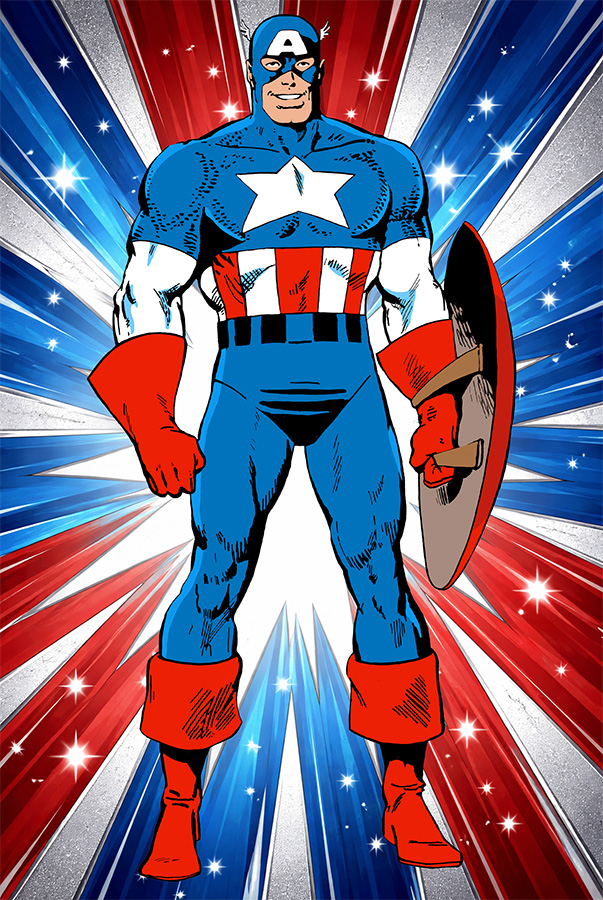
Captain America
Steven Grant Rogers
ACTIVE
- Known Aliases: Nomad; The Captain
- Identity: Publicly known
- Occupation: Adventurer; former soldier; former freelance artist
- Legal Status: Citizen of the United States with no criminal record
- Place of Birth: New York City, New York
- Marital Status: Single
- Known Relatives: Joseph Rogers (father, deceased), Sarah Rogers (mother, deceased)
- Group Affiliation: Avengers; Invaders (former); Secret Avengers (former); partner of Bucky Barnes and the Falcon
- Base of Operations: New York City; formerly Avengers Mansion
- Education: High school graduate; military training
- Species: Human (Enhanced)
- Gender: Male
- Height: 6 ft. 2 in.
- Weight: 240 lbs.
- Eyes: Blue
- Hair: Blond
- Distinguishing Features: Perfectly proportioned physique enhanced to peak human potential
Steven Grant Rogers was born during the Great Depression in New York City, growing up a frail and sickly youth in a poor household. His father died during his childhood, and his mother passed away when he was a young man, leaving him alone in the world. Despite his physical limitations, Rogers possessed an unshakable sense of duty and moral conviction. Horrified by the rise of Nazi Germany, he attempted to enlist in the United States Army, only to be rejected due to his poor health.
His determination drew the attention of General Chester Phillips, who offered him a place in a top-secret experiment known as Operation: Rebirth. Rogers was selected by Dr. Abraham Erskine to receive the Super-Soldier Serum, a formula designed to enhance the human body to peak perfection. Following administration of the serum and exposure to vita-rays, Rogers was transformed into the pinnacle of human physical potential. Moments after the experiment’s success, Erskine was assassinated by a Nazi spy, leaving Rogers as the only successful recipient of the formula.
Expand full history
Rogers underwent intensive training in combat, tactics, and espionage before being deployed as Captain America, a living symbol of American ideals. Armed with a vibranium shield, he quickly became one of the Allies’ most effective operatives during World War II. Alongside his partner Bucky Barnes, Captain America fought numerous Axis threats, including the Red Skull, Baron Zemo, and Hydra.
During the final days of the war, Captain America attempted to stop a drone plane loaded with explosives launched by Baron Zemo. The plane exploded, killing Bucky and sending Rogers into the icy waters of the North Atlantic. The Super-Soldier Serum preserved his body in suspended animation, leaving him frozen for decades.
He was discovered and revived by the Avengers in the modern era, joining the team and quickly becoming one of its central leaders. Struggling to adapt to a world vastly different from the one he knew, Rogers nevertheless remained steadfast in his ideals, becoming a moral anchor for the superhero community.
Over the years, Captain America faced numerous threats, including Hydra’s resurgence, the manipulations of the Red Skull, and internal conflicts within the United States government. His sense of duty often placed him at odds with authority, most notably when he abandoned the Captain America identity and became Nomad after losing faith in the government during the Secret Empire crisis.
Rogers later resumed the mantle of Captain America and continued his role as a leading Avenger. He formed close partnerships with heroes such as the Falcon, Sharon Carter, and later his former sidekick Bucky Barnes, who returned as the Winter Soldier.
During the Superhuman Civil War, Captain America opposed the Superhuman Registration Act, leading a resistance movement against government control of superheroes. His stance led to a direct conflict with Iron Man and ultimately resulted in his apparent assassination following his surrender.
Rogers was later revealed to have been displaced in time rather than killed, and he eventually returned to reclaim his role. During his absence, Bucky Barnes temporarily assumed the mantle of Captain America, with Rogers later endorsing him as his successor.
In subsequent years, Rogers faced ongoing threats from Hydra, including a period in which his history was altered, leading to a version of Captain America loyal to Hydra. This distortion was ultimately undone, restoring Rogers’ true identity and legacy.
In the period following the restoration of his true identity after the Hydra-altered reality, Steve Rogers faced one of the most significant challenges of his life: rebuilding trust. Although the world came to understand that his actions as a Hydra agent were the result of cosmic manipulation, the psychological and political damage remained profound. Many questioned whether Captain America could still represent the ideals he once embodied, forcing Rogers to confront not an external enemy, but a crisis of legacy.
Determined to prove that his values were not defined by perception but by action, Rogers returned to active duty as both a field operative and leader. He resumed a central role within the Avengers, helping to stabilize the team during a time of increasing global instability. Under his leadership, the Avengers restructured into a more proactive force, operating on a global—and at times cosmic—scale to confront emerging threats.
During this era, Rogers became increasingly involved in large-scale geopolitical and interdimensional conflicts. He played a key role in confronting threats such as the Final Host of the Celestials, ancient beings whose return to Earth threatened total planetary destruction. As part of this conflict, Rogers demonstrated his continued ability to lead under extreme pressure, coordinating heroes across multiple fronts while maintaining unity among vastly different personalities and power levels.
Rogers also became involved in conflicts stemming from shifts in the global balance of power, including tensions surrounding Wakanda, Atlantis, and other sovereign superhuman nations. His role often placed him in morally complex situations, where traditional definitions of right and wrong were blurred by political realities. Despite this, he remained committed to acting according to principle rather than convenience.
In addition to global conflicts, Rogers continued to engage in more grounded operations, frequently confronting Hydra remnants, terrorist organizations, and domestic threats. These missions reinforced his enduring role not just as a symbol, but as an active protector of civilians.
Throughout the modern era, Rogers has also taken on a mentorship role, guiding younger heroes and helping to shape the next generation of Avengers. His experience—spanning World War II to the present—gives him a unique perspective that few others can match.
Despite decades of conflict, loss, and personal upheaval, Steve Rogers remains unwavering in his core belief: that the ideals of freedom, justice, and responsibility must be upheld, even when the world itself seems to reject them. In a time when symbols are often questioned or redefined, Captain America continues to stand not as a relic of the past, but as a living standard against which heroism is measured.
Strength Level: Captain America represents the pinnacle of human physical perfection. While not superhuman, he can lift approximately 800 pounds under optimal conditions.
Known Superhuman Powers: Captain America’s physiology has been enhanced by the Super-Soldier Serum to the peak of human potential. He possesses superior strength, speed, agility, endurance, reflexes, and durability. His body efficiently eliminates fatigue toxins, granting him exceptional stamina and recovery.
Other Abilities: Master tactician and field commander; expert in hand-to-hand combat (boxing, judo, and his own hybrid style); skilled acrobat and gymnast; experienced military strategist; proficient with firearms and other weapons.
Expand full details
Captain America’s mental faculties are also enhanced, allowing for rapid tactical assessment and near-perfect recall. His combat experience spans decades of warfare across multiple eras.
Limitations: Captain America is still fundamentally human and subject to injury or death if sufficiently harmed. His abilities, while extraordinary, do not exceed natural human limits enhanced to their peak.
Captain America carries a circular shield composed of a unique vibranium alloy. The shield is virtually indestructible and capable of absorbing and redistributing kinetic energy. Its aerodynamic design allows it to be thrown with extreme precision, ricocheting off surfaces and returning to its wielder. It serves as both an offensive and defensive tool and is considered one of the most effective weapons in the Marvel Universe.
- Origin of Captain America (Captain America Comics #1, 1941)
- World War II missions with Bucky (Captain America Comics #1–10, 1941–1942)
- First battles with Red Skull (Captain America Comics #7, 1941)
- Final WWII mission and apparent death (Avengers #4, 1964 - retold)
- Revived by the Avengers (Avengers #4, 1964)
- Becomes Avengers leader (Avengers #16, 1965)
Expand full details
- Battles Baron Zemo legacy (Avengers #15–16, 1965)
- Secret Empire / becomes Nomad (Captain America #169–176, 1974)
- Returns as Captain America (Captain America #180, 1974)
- Serpent Society conflicts (Captain America #310–315, 1985)
- The Captain identity (Captain America #332–350, 1987–1989)
- John Walker becomes Captain America (Captain America #333, 1987)
- Onslaught event (Captain America #445–448, 1996)
- Heroes Reborn / Return (Captain America Vol. 2 #1, 1996; Vol. 3 #1, 1998)
- Winter Soldier revealed (Captain America Vol. 5 #1–6, 2005)
- Civil War leadership (Civil War #1–7, 2006–2007)
- Assassination of Captain America (Captain America #25, 2007)
- Return through time displacement (Captain America: Reborn #1–6, 2009)
- Bucky as Captain America (Captain America Vol. 5 #34–50, 2008–2011)
- Secret Avengers formation (Secret Avengers #1, 2010)
- Avengers vs. X-Men (Avengers vs. X-Men #1–12, 2012)
- Hydra Cap reality alteration (Captain America: Steve Rogers #1–19, 2016–2017)
- Secret Empire (Secret Empire #0–10, 2017)
- Return to true identity (Captain America #695–700, 2018)
- Modern leadership of Avengers (Avengers Vol. 8 #1, 2018)
Film
| Title | Year | Portrayed By | Notes |
|---|---|---|---|
| Captain America (serial) | 1944 | Dick Purcell | First live-action adaptation |
| Captain America | 1990 | Matt Salinger | Feature film adaptation |
| Captain America: The First Avenger | 2011 | Chris Evans | MCU origin film |
| The Avengers | 2012 | Chris Evans | Avengers assembled |
| Captain America: The Winter Soldier | 2014 | Chris Evans | Hydra infiltration storyline |
| Avengers: Age of Ultron | 2015 | Chris Evans | Continued Avengers leadership |
| Captain America: Civil War | 2016 | Chris Evans | Superhuman Registration conflict |
| Avengers: Infinity War | 2018 | Chris Evans | Appears as fugitive Steve Rogers |
| Avengers: Endgame | 2019 | Chris Evans | Final major MCU appearance |
Television / Animation
| Title | Year(s) | Voiced By | Notes |
|---|---|---|---|
| Spider-Man | 1994–1998 | David Hayter | Guest appearance |
| The Avengers: United They Stand | 1999–2000 | Dan Chameroy | Guest appearance |
| The Avengers: Earth's Mightiest Heroes | 2010–2012 | Brian Bloom | Core team member |
| Ultimate Spider-Man | 2012–2017 | Roger Craig Smith | Recurring role |
| Avengers Assemble | 2013–2019 | Roger Craig Smith | Team leader |
| X-Men '97 | 2024– | Josh Keaton | Guest appearance |
Video Games
| Title | Year | Voice Actor | Notes |
|---|---|---|---|
| Marvel Rivals | 2024 | Brian Bloom | Playable character |
| Marvel Snap | 2022 | — | Card-based appearance |
| Marvel’s Avengers | 2020 | Jeff Schine | Main playable Avenger |
| Disney Infinity 2.0 | 2014 | Roger Craig Smith | Avengers playset |
| LEGO Marvel Super Heroes | 2013 | Roger Craig Smith | Playable character |
| Marvel Heroes | 2013 | Brian Bloom | Action RPG |
| Captain America: Super Soldier | 2011 | Chris Evans | Film tie-in |
| Marvel: Ultimate Alliance 2 | 2009 | Brian Bloom | Civil War storyline |
| Marvel: Ultimate Alliance | 2006 | Trevor Devall | Playable character |
| Captain America and The Avengers | 1991 | — | Arcade beat 'em up |